PIDs required from 1 November 2026

  • Sep 4, 2026 8:21 AM UTC
  • 7 replies
  • 34 views

jake_kirkham

As of 1 Nov, PIDs are required when shipping into the EU:

The three PIDs you need to provide

1. Merchant PID (M-PID) - always required

Assigned by the online seller, marketplace, or platform. It has to uniquely identify the product across that platform, no matter how many sellers offer it.

In practice, this is the platform SKU or listing ID you already use on your storefront. Your Shopify product ID or internal catalog reference covers it.

2. Non-Standardized Manufacturer PID (NS-PID) - always required

Assigned by the manufacturer, producer, or supplier. It does not rely on any international standard. If no NS-PID exists yet, the manufacturer is expected to create one. There's no required structure.

In practice, this is the manufacturer's internal model number, style code, or production reference, something like "MX-2024-BLK-L" for a black jacket in size L. If your supplier has never assigned one, they need to. The format is flexible.

3. Standardized Manufacturer PID (S-PID) - required where it exists, with a mandatory exception code where it doesn't

This one relies on internationally recognized standards. In Europe, that usually means the EAN (European Article Number) for most products and the ISBN for books.

In practice, this is the EAN barcode printed on the product or its packaging, the 13-digit number under the barcode. For books, the ISBN. If a product genuinely has no standardized barcode (which is rare for mainstream consumer goods) you have to explicitly declare that none exists. Silence will not clear customs.

The European Commission's official guidance document (PDF) walks through edge cases for each identifier type if you need to check a specific product category.


Shipstation doesn’t have a way to add EANs to Customs forms. A workaround is to add EAN to SKU line, but this would be for reference only and unlikely to be picked up by Customs.

Has anyone worked out how to do this yet?

7 replies

  • Community Manager
  • Sep 4, 2026 3:24 PM UTC

Hey there 

Thanks for bringing this up Your breakdown of the new EU PID rules is spot on. 

To answer your question directly: we are fully aware of the November 1 deadline, and our team is already on it.

Our engineering team is actively building out dedicated fields for these exact identifiers (Merchant ID, Non-Standardized ID, and Standardized ID like EAN/UPC) specifically for international customs declarations.

We will post an official update with instructions once the new fields are live in the UI. Thanks for staying ahead of the curve on this!


SydSegal
  • Employee
  • Sep 7, 2026 5:30 AM UTC

Hey there 

Thanks for bringing this up Your breakdown of the new EU PID rules is spot on. 

To answer your question directly: we are fully aware of the November 1 deadline, and our team is already on it.

Our engineering team is actively building out dedicated fields for these exact identifiers (Merchant ID, Non-Standardized ID, and Standardized ID like EAN/UPC) specifically for international customs declarations.

We will post an official update with instructions once the new fields are live in the UI. Thanks for staying ahead of the curve on this!


Thank you for the update JuanAdmin.


Do you know if these new fields for details will be linked back to corresponding fields within Shopify? Many users of ShipStation use Shopify, so having all of the details in Shopify import over to ShipStation automatically (for customs documentation) would be ideal. Within Shopify, on an individual Product page, there is already a SKU field (which imports to ShipStation). There is a metafield for ISBN, which I hope will import over to ShipStation once ShipStation completes their UI updates. But what about Non-Standardized Manufacturer PID? I do not believe that Shopify currently features an area for this type of detail. Assuming Shopify does implement a metafield or some other section within the Product area, will ShipStation work on making a connection between the two platforms so all of the updated/required information is automatically brought over on store import?


Thanks


jake_kirkham
  • Author
  • Employee
  • Sep 7, 2026 9:30 AM UTC

Many thanks for your update. The support team were unaware of this when we chatted last week. Good to know it’s going to be covered. Thanks.


  • Community Manager
  • Sep 8, 2026 2:37 PM UTC

Thank you for the update JuanAdmin.


Do you know if these new fields for details will be linked back to corresponding fields within Shopify? Many users of ShipStation use Shopify, so having all of the details in Shopify import over to ShipStation automatically (for customs documentation) would be ideal. Within Shopify, on an individual Product page, there is already a SKU field (which imports to ShipStation). There is a metafield for ISBN, which I hope will import over to ShipStation once ShipStation completes their UI updates. But what about Non-Standardized Manufacturer PID? I do not believe that Shopify currently features an area for this type of detail. Assuming Shopify does implement a metafield or some other section within the Product area, will ShipStation work on making a connection between the two platforms so all of the updated/required information is automatically brought over on store import?


Thanks

I can’t answer this as of right now, but I’ll ask the product team and find out as soon as possible. 


SydSegal
  • Employee
  • Oct 20, 2026 3:05 AM UTC

Thank you for the update JuanAdmin.


Do you know if these new fields for details will be linked back to corresponding fields within Shopify? Many users of ShipStation use Shopify, so having all of the details in Shopify import over to ShipStation automatically (for customs documentation) would be ideal. Within Shopify, on an individual Product page, there is already a SKU field (which imports to ShipStation). There is a metafield for ISBN, which I hope will import over to ShipStation once ShipStation completes their UI updates. But what about Non-Standardized Manufacturer PID? I do not believe that Shopify currently features an area for this type of detail. Assuming Shopify does implement a metafield or some other section within the Product area, will ShipStation work on making a connection between the two platforms so all of the updated/required information is automatically brought over on store import?


Thanks

I can’t answer this as of right now, but I’ll ask the product team and find out as soon as possible. 


Hi Juan,


After a lengthy chat with ShipStation support yesterday, ShipStation is currently not mapping these very specific details (like NS-PID, Barcodes, Country of Origin, and HS Codes) into the appropriate area within ShipStation upon order import. This is something that should be done asap specific for brands that use Shopify and implement all of these numbers/codes/settings directly in Shopify. ShipStation already has the ability to map the SKU, weight of a product, a product name, all of the ship to details, etc. and all of that information currently comes through on a store import. Seeing as these additional details are now needed more than ever (for international shipping, especially to EU countries as of Nov. 1st), ShipStation needs to work on importing this data that is in place in Shopify (assuming its been added by the Shopify user) directly into ShipStation where its needed. 


And I understand that ShipStation offers a Product section in which you can import product details or add the details product by product manually… but that is not an efficient workaround when ShipStation is already importing all of the information mentioned above. It really shouldn’t be too difficult to import this data and map it to the appropriate section within ShipStation’s customs area. 


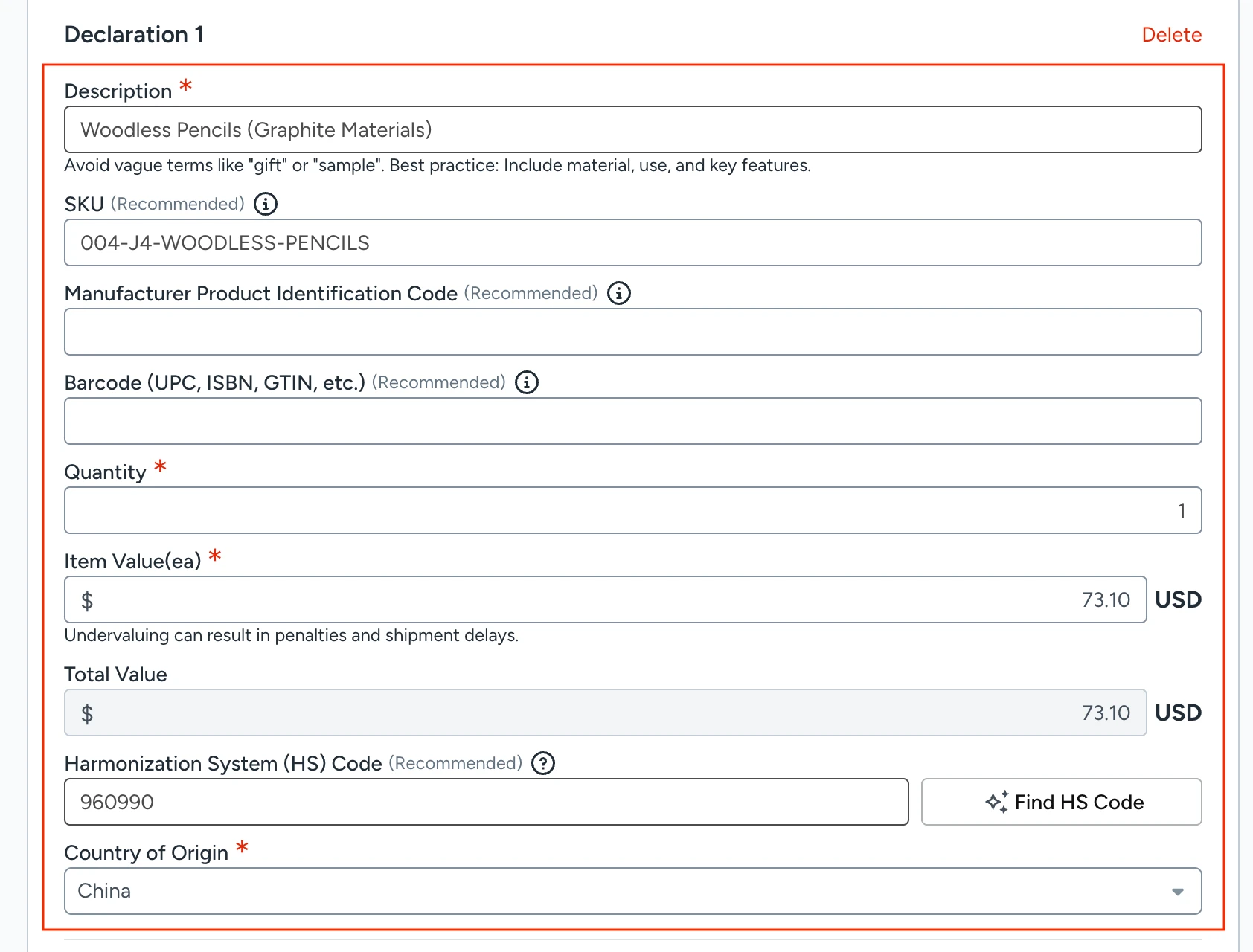
Below is a screenshot of how a customs form in ShipStation looks specifically to an EU country. All of the information circled in RED is information currently present on the specific Product page within Shopify and present in the order being imported. However, ShipStation is not bringing in all of that information (like the Manufacturer Product ID, Barcode, HS code or Country of Origin). There has to be a way, without dealing with the ShipStation Products section, to import and populate this information (as long as its present in Shopify) to these specific areas in customs.


Thanks,

Syd


  • Community Manager
  • Oct 20, 2026 8:36 PM UTC

Hey Syd, 

No exact date, but it appears to me that the product team is aware of this request, and are actively looking into it. 

Thank you for your well thought out post, it showed why this is desperately needed, and made it easier to make the case why this is a necessary feature! 


SydSegal
  • Employee
  • Oct 26, 2026 6:09 AM UTC

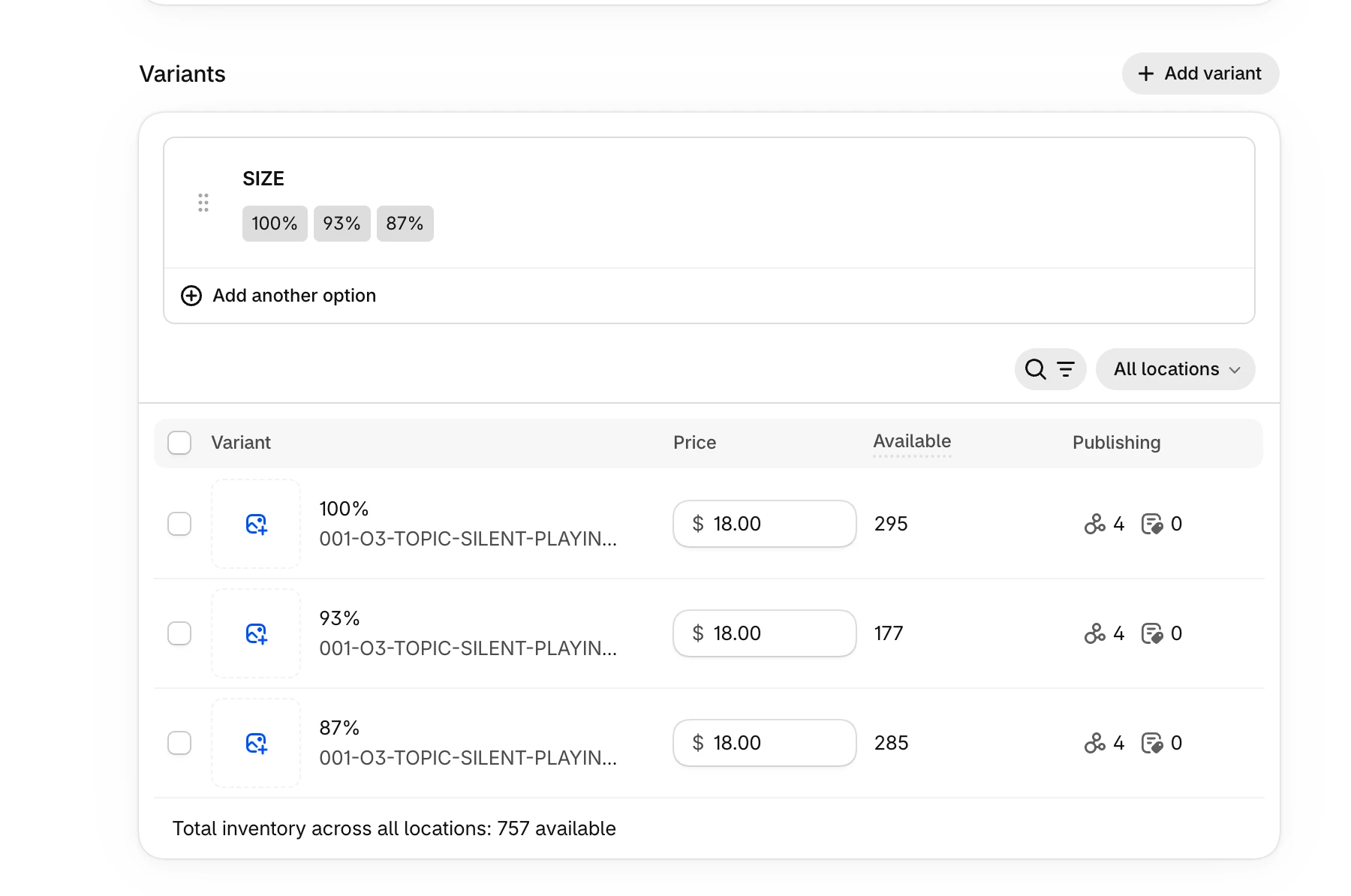
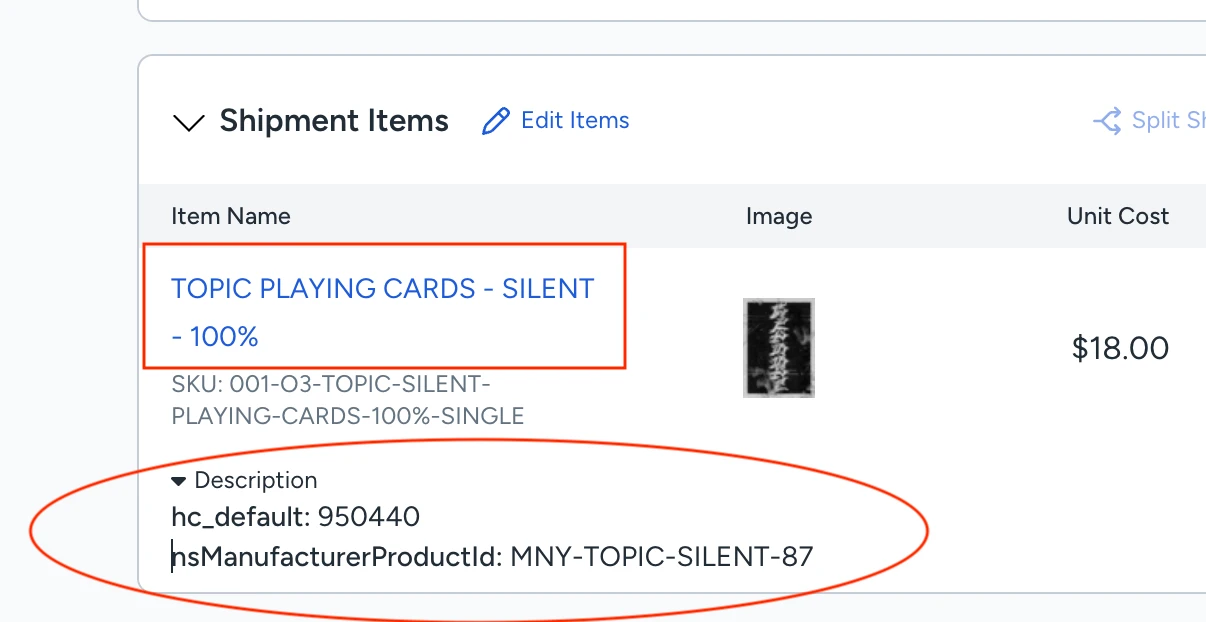
Hi Juan, here is another issue I am noticing between Shopify and ShipStation in regards to pulling the NS-PID numbers over. While they are not being populated directly into the customs forms in ShipStation, ShipStation is pulling the details and adding it underneath the product under Shipment Items. However, in the event that the product being imported is part of variants (like different sized tshirts within Shopify, different SKUs/sizes but under a single product), ShipStation is simply pulling the NS-PID number from (what looks like) the 1st product in the variants.


See the pictures below that show 3 product types (variants) currently set up in Shopify:


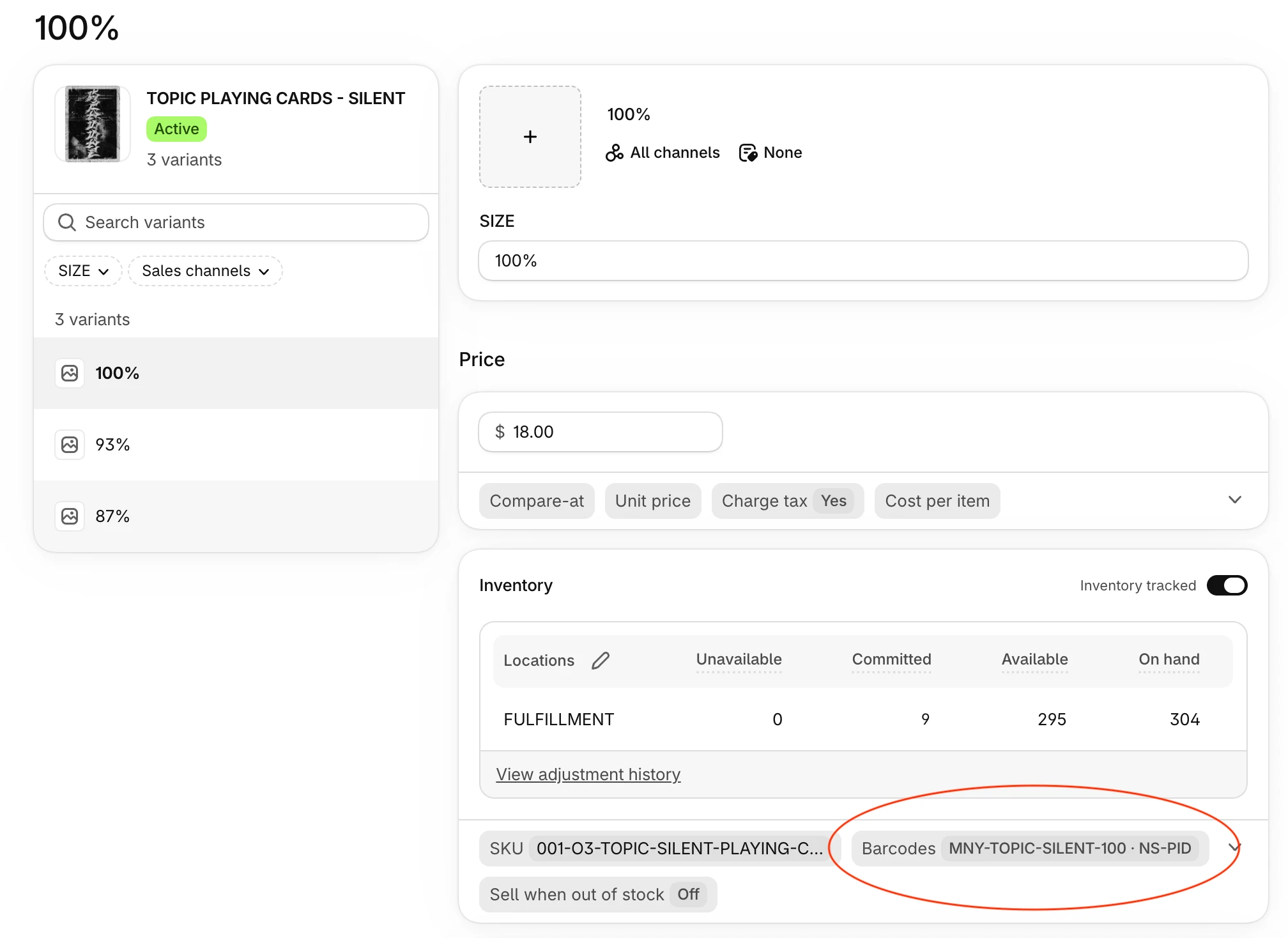
This is a deeper look into the “100%” variant with its own NS-PID:


However, upon import into ShipStation, this specific SKU is showing the NS-PID for another variant in that product line within Shopify:


Can you please send this to the support / product team to figure out why ShipStation is pulling the incorrect NS-PID from a group of variant products?


Thank you,

Syd